Sunday, December 19th. I fly home in five days. Wasn't my last post about the items I forgot to pack?
I had my Arabic post-test today to gauge how much Arabic I've learned since I've been here. I have learned so much, and even some Arabic on top of that.
Friday I had lunch at a friend's house. I met his four brothers and some relatives, as per usual. They served me sacchan: a plate piled high with Arabic flat bread 18" wide and grilled with spices, olive oil, roasted almonds and onions, topped with seasoned chicken. I was eating too slowly for them to wait to fill my plate with a different dish of rice and chicken, so they made another plate for me. My friend smiled at me and whispered, "You know you have to finish it all." The family was so sweet, smiling and talking in Arabic and English while they watched me eat... they were long done by the time I started on the plate of rice. It felt like Thanksgiving, except now I was eating alone and with an audience. Lesson #1: hospitality is very important. Not only are you graciously welcomed into the home, you are treated as family. And you are fed... a lot.
After lunch, we talked over chai about American verses Arabic culture, and of course - politics. Lesson #2: Jordanians, Muslims, Arabs - they are eager to tell me that they are much different from the image portrayed in American media. They want me to know that they don't have red horns. They want me to know that they are people. It is very important to them that I understand this. Understandably so.
When the sun was just about to set, we went for a walk in the neighborhood. We passed an enclosed tent with a line of women in fashionable hijaba garb waiting to enter. There was music coming from the tent, older women expressed their excitement in loud trills, and the sides of the tent shook from dancing. The wedding celebration for the women.
Up a ways, we passed another tent where the men were. It was three sided, opened to passerbys. All the men were seated. There was no music and only quiet conversations between the men. My friend explained that this was the official engagement ceremony. The women don't need to be present, the bride already knows she is engaged. But here, the men are sealing the engagement, they are shaking hands, and drinking Arabic coffee.
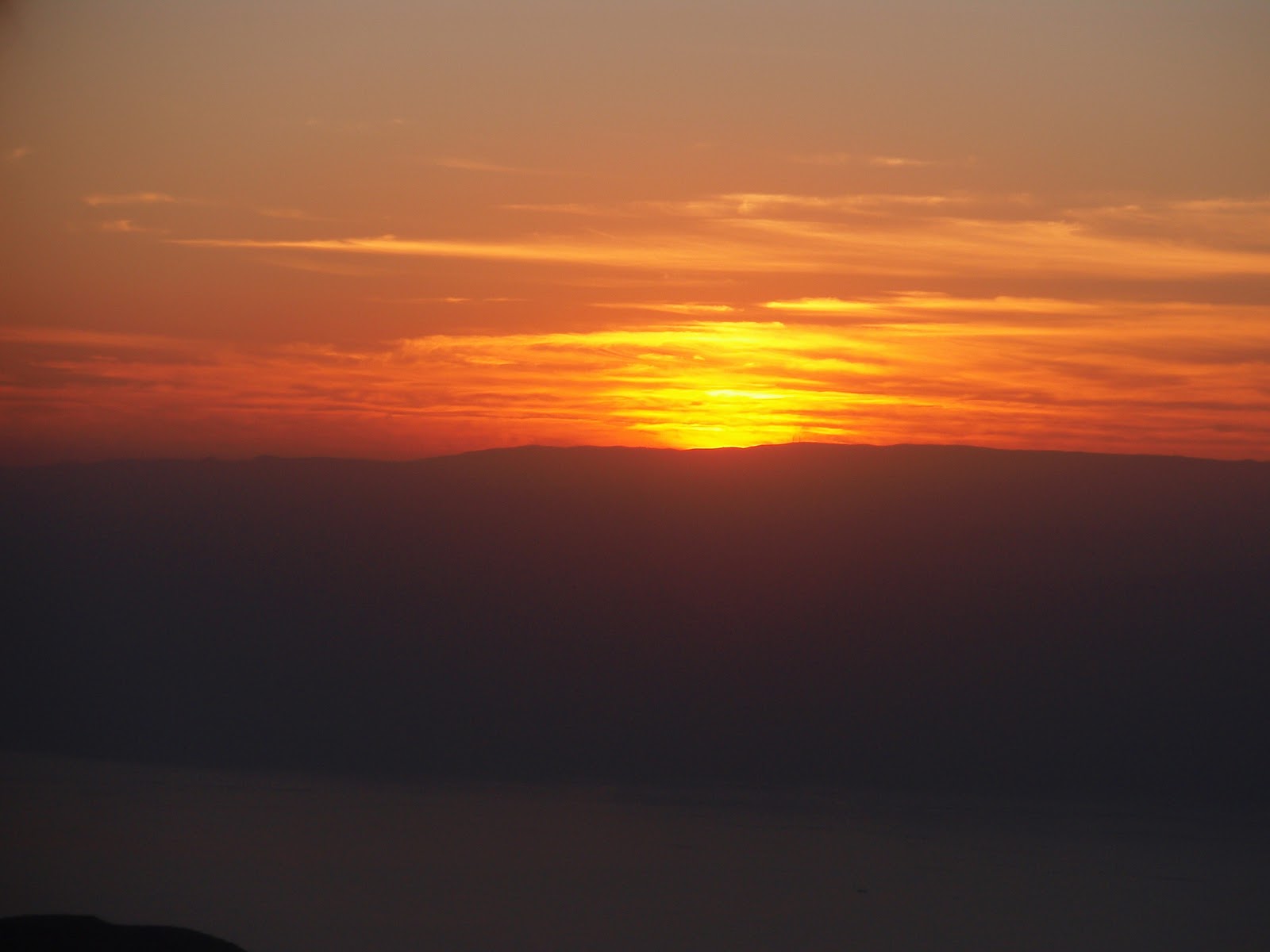
We stopped walking when the houses ended and the valley opened up below us. We stood on a ledge, looking out across the valleys and hills of Amman and watched as the sun set over the furthest jebal and the lights turned on little by little. This is my favorite place in Amman. Maybe one of my favorite places in the world. I am not alone: the road along this ledge is lined with parked cars and cabs. They sit there with their friend, brother, or lover, sipping Nescafe and watching the sky change and the valley light up.
Lesson #3: Jordanians value time spent sitting. Sitting together, always together.
Sunday, December 19, 2010

Monday, December 6, 2010
Biblical/Political Jordan
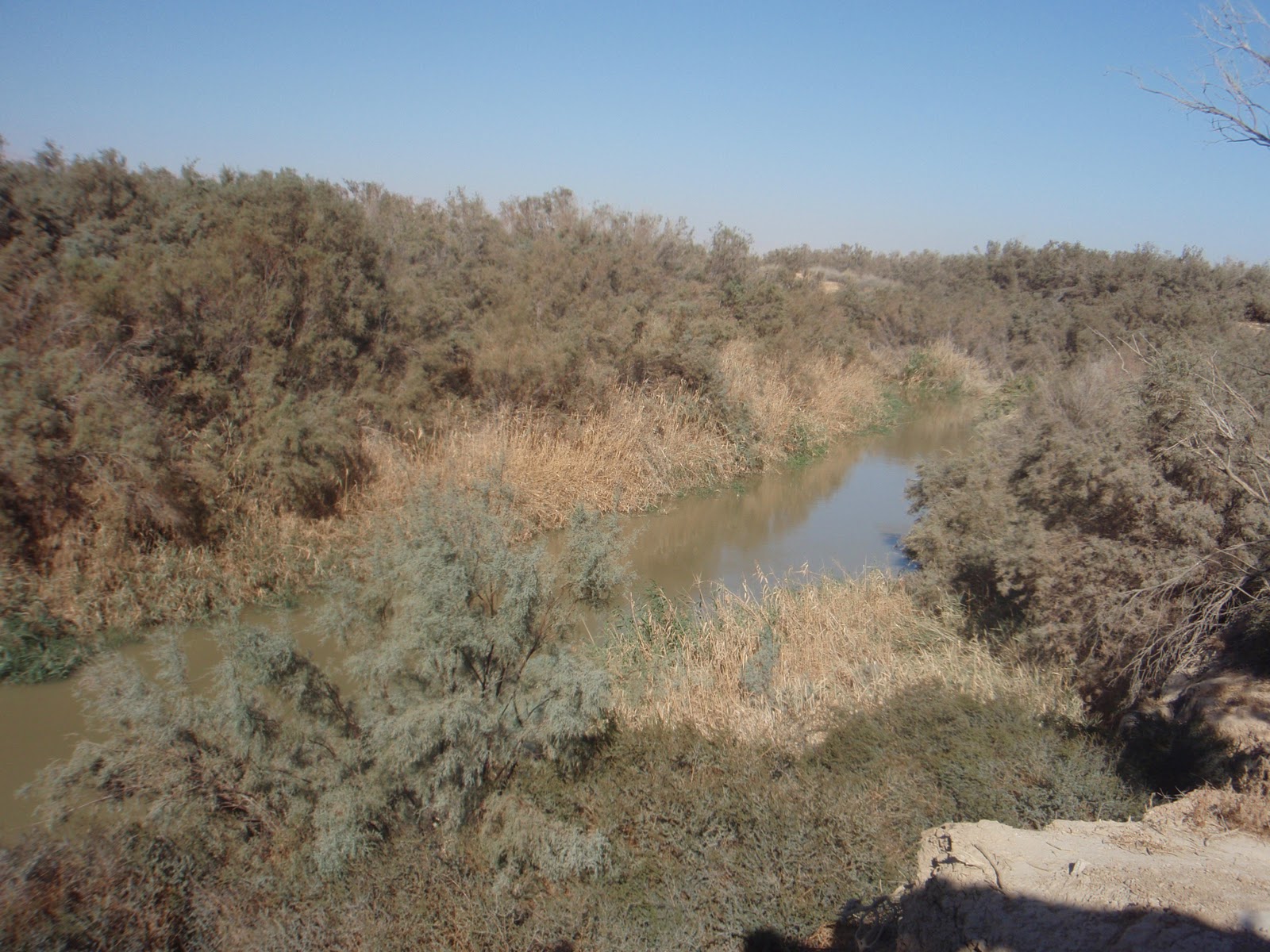
First stop: the Jordan River. Originally something like 300 feet wide, today there are parts that I can leap over. This particular spot, where Jesus was baptized by John the Baptist, is about 25 feet wide. Some gross percentage of the river is being diverted for irrigation - handily blamed on Israel, but Syria plays a large role in taking its water as well. Jordan is the last to take from it, a small 5% or so in comparison to its neighbors.


Sunday, December 5, 2010
A Traveler's Dilemma
It's raining at last. November is when the "rains" are supposed to start, but it was a dry month. Jordan is desperately in need of some rain. All the new developments have wells to catch any rainwater. We pray for rain, and then thank God for rain when it eventually comes.
These days, conversations in the program mostly consist of holiday plans, how wonderful Christmas will be in the States, and so on. Some Jordanian friends have told me they would love to someday experience Christmas in America. I tell them they should. And then they look at me like I am silly, and say, "It's almost impossible to get a visa."
Why? Quite simply - and the embassy does not even try to sugar coat the reasons - because they are twenty something unmarried men, without children, and are originally Palestinian. It's not just the U.S. of course that has major restrictions on visa applicants. My friend was requested by a Norwegian international music festival to come and play the oud (classical Middle Eastern instrument) and teach it to music students. Norway wouldn't let him in, even after the festival appealed three times.
I understand why there are these restrictions. Of course I do. But it's hard having this freedom to travel to most countries and knowing people just like me who want to study elsewhere and to see the world, but can't because they were born in a land that is seen as a threat. It is next to impossible for them to travel to the Western world. They have to be punished for acts of terrorism that they themselves condemn.
But what else can America do, or any other western nation? A child's cry of "it's not fair," is unproductive.
Tuesday, November 30, 2010
What's (not) in the news...
There are three things considered haram (forbidden) to talk about in public media, and often times in public as well:
1) Allah
2) sex
3) politics - especially domestic politics, no criticizing the king
Just think about the effects this can have on a society.
1) Allah
2) sex
3) politics - especially domestic politics, no criticizing the king
Just think about the effects this can have on a society.
Friday, November 26, 2010
Eid al-Shkra (Thanksgiving)
I was a little sad that I couldn't celebrate Thanksgiving with my family, but I did learn how to have Thanksgiving in a country that obviously does not celebrate this holiday, or even have pumpkins.
We had classes on Thursday, but that didn't set back the girls and I who planned to have a Thanksgiving feast that night. We scoured the supermarket for any Thanksgiving like foods, took our goods back to our various kitchens, and set about preparing our designated dishes. I was in charge of the sweet potato souffle and sweet potato pie. I had to buy a million and one sweet potatoes because here they are the size of Vienna Fingers. Samanthi, the maid, helped me peel the potatoes. Then I bonded with my host sister as we threw sugar, eggs, milk and cinnamon into various bowls, and mashed the potatoes into oblivion. My friends insisted on putting marshmallows on the souffle (what the heck?) but I complied, and sprinkled the dish with pink and yellow heart shaped marshmallows. Marshmallows are more of a sweet snack for children, I learned, instead of for hot cocoa or s'mores.
The spread was impressive. Sliced deli turkey, french bread, gravy from a packet, stuffing from a box, cranberry sauce from a can, mashed potatoes from a bag, and chai. Afterward, we ate homemade pecan pie and sweet potato pie. It more than sufficed for a Thanksgiving abroad. More importantly, we were thankful for the support we provided each other in a place that is so extremely different from home and thankful for the opportunity to gather as we did to celebrate Thanksgiving.
We had classes on Thursday, but that didn't set back the girls and I who planned to have a Thanksgiving feast that night. We scoured the supermarket for any Thanksgiving like foods, took our goods back to our various kitchens, and set about preparing our designated dishes. I was in charge of the sweet potato souffle and sweet potato pie. I had to buy a million and one sweet potatoes because here they are the size of Vienna Fingers. Samanthi, the maid, helped me peel the potatoes. Then I bonded with my host sister as we threw sugar, eggs, milk and cinnamon into various bowls, and mashed the potatoes into oblivion. My friends insisted on putting marshmallows on the souffle (what the heck?) but I complied, and sprinkled the dish with pink and yellow heart shaped marshmallows. Marshmallows are more of a sweet snack for children, I learned, instead of for hot cocoa or s'mores.
The spread was impressive. Sliced deli turkey, french bread, gravy from a packet, stuffing from a box, cranberry sauce from a can, mashed potatoes from a bag, and chai. Afterward, we ate homemade pecan pie and sweet potato pie. It more than sufficed for a Thanksgiving abroad. More importantly, we were thankful for the support we provided each other in a place that is so extremely different from home and thankful for the opportunity to gather as we did to celebrate Thanksgiving.
Tuesday, November 23, 2010
The Good and the Bad
Eid al-Adha is over. Students are back from their excursions around the Middle East. I am lamenting the lack of pumpkin in Jordan. Term paper deadlines are approaching fast and furious while available weekends are diminishing at a seemingly more rapid pace. I am engrossed in research about the Moslem Brethren of Syria - unfortunately, Syria does not like to publish anything that might mar their reputation. And I am out of peanut butter.
Thus, I think it is the perfect time to share with you what I love about Jordan.
1) I know I've said this before, but I love the evenings. The air is cool, the setting sun casts a pink glow on the white buildings of the city, things quiet down, and visitors come calling to sit on the veranda and sip chai while enjoying relaxed conversation. I often curl up on the couch with various members of my host family, and half watch the TV, half listen to the conversations around me. Evenings are beautiful.
2) I love the call to prayer. Five times throughout the day, it gives a sense of continuity and stability to the day, the week, to life. The prayers are not all the same: some lamenting and sad, some deep and beautiful, and some passionate and commanding. I don't know what they say, but nonetheless, the sound is beautiful, echoing from minaret to minaret to cover the city in reminder to pray. (Side note: Koranic verse is very complicated because of its old vernacular - many Arabs do not understand what some of the words mean.)
3) There is something delightful about standing in line at the closest falafel shop to get your 50 cent sandwich. The pita is warm, the falafel is fresh, and the hummus is creamy: zakey kateer and the perfect mid-day lunch to get you through the rest of the day's classes.
4) When you greet someone here and ask how they are doing, a common response is alhamdulillah, meaning "Praise be to God." I find that nice. If their day is going well, they immediately respond by giving God the credit. I know that the response has become casual and probably off-hand without much thought to the meaning, but as a foreigner to this culture, I find the practice interesting.
5) Produce trucks - I really like the produce trucks. Not only do they sit on the side of the road loaded to overflowing with fresh bananas, pomegranates, etc., often topped with a young boy sitting non-chalantly on his throne of fruit; these trucks are also bejeweled with hearts and swirls of metallic colors painted on the truck's sides. It's a fun sight.
6) Finally, I like the cats. They are at every dumpster, by every street corner: calicoes, tortoise-shelled, tabbies, every color with yellow and green eyes pausing to watch you pass. These are cats that frequent trash heaps, but their grace and posture would have them exploring marble halls instead.
These are just a few things I like about Jordan, but these six are what I see and experience everyday. Little things, yet they are happy.
A happy Thanksgiving to all!
Thus, I think it is the perfect time to share with you what I love about Jordan.
1) I know I've said this before, but I love the evenings. The air is cool, the setting sun casts a pink glow on the white buildings of the city, things quiet down, and visitors come calling to sit on the veranda and sip chai while enjoying relaxed conversation. I often curl up on the couch with various members of my host family, and half watch the TV, half listen to the conversations around me. Evenings are beautiful.
2) I love the call to prayer. Five times throughout the day, it gives a sense of continuity and stability to the day, the week, to life. The prayers are not all the same: some lamenting and sad, some deep and beautiful, and some passionate and commanding. I don't know what they say, but nonetheless, the sound is beautiful, echoing from minaret to minaret to cover the city in reminder to pray. (Side note: Koranic verse is very complicated because of its old vernacular - many Arabs do not understand what some of the words mean.)
3) There is something delightful about standing in line at the closest falafel shop to get your 50 cent sandwich. The pita is warm, the falafel is fresh, and the hummus is creamy: zakey kateer and the perfect mid-day lunch to get you through the rest of the day's classes.
4) When you greet someone here and ask how they are doing, a common response is alhamdulillah, meaning "Praise be to God." I find that nice. If their day is going well, they immediately respond by giving God the credit. I know that the response has become casual and probably off-hand without much thought to the meaning, but as a foreigner to this culture, I find the practice interesting.
5) Produce trucks - I really like the produce trucks. Not only do they sit on the side of the road loaded to overflowing with fresh bananas, pomegranates, etc., often topped with a young boy sitting non-chalantly on his throne of fruit; these trucks are also bejeweled with hearts and swirls of metallic colors painted on the truck's sides. It's a fun sight.
6) Finally, I like the cats. They are at every dumpster, by every street corner: calicoes, tortoise-shelled, tabbies, every color with yellow and green eyes pausing to watch you pass. These are cats that frequent trash heaps, but their grace and posture would have them exploring marble halls instead.
These are just a few things I like about Jordan, but these six are what I see and experience everyday. Little things, yet they are happy.
A happy Thanksgiving to all!
Tuesday, November 16, 2010
Brewings Over Coffee
I sat behind the counter with the shop owner, talking about politics, religions and cultures, sipping the drink of choice in Jordan: Nescafe. I walk by his shop everyday going to class, saying "marhaba!" as I pass. With classes off for Eid Al-Adha, I was able to finally have our promised conversation over coffee. It was the second conversation of the day about Israel, Palestine, and American politics in the region. Jordanians certainly have their opinions. And if they're Palestinian, they hold tightly to their wounds and cling to their memories. "We have been here for fifty years, and everyday I have heard my father talk about his home in Palestine. Everyday." Many say they just don't understand why the land can't be shared, why Israel wants it all, why Hamas keeps killing. "There are no differences between the Arabs and the Americans - except that America decided to support Israel. That is the only reason for trouble. Arabs do not understand why America takes the side of Israel."
I have to choose my responses carefully, mostly I resort to nodding my head, listening and saying, "it is sad," from time to time. It's not my goal to argue - I want to listen. At some point in almost every conversation like this, I am asked, "Why are you studying here? Why politics? It is so complicated and politicians are liars everywhere." I tell them I am here because I don't understand, but want to. There is too much ignorance and I wanted to learn the stories here and not just be taught the American perspective.
There is a lot of ignorance in the States. I came here so that I would not have to be influenced solely by the perspectives of my American professors, peers and family. As much as I respect those opinions, there is another side to the story that I don't hear. In Jordan, I have found another ignorance. They tell me that they know what it is like in America. I am told that we are all blinded by the Jewish influence on the media. That we only see it one way and will never take the side of the Arabs. I am told what we Americans think and why we think it. (I am talking only about politics here, but their ideas about our culture and lifestyles are as great and broad as our perception of the Arab culture and lifestyle.) They then tell me what the Israeli government thinks and why they continue their settlements. The Jordanians inform me of the Palestinians desire to take over in Jordan and the Palestinians tell me of the Jordanian persecution of Palestinians. There is a lot of animosity between Jordanians and Palestinians, between Arabs and the American government (I have been told countless times that they love the American people, they just don't agree with the government), and obviously the animosity between Arabs and Israelis. And ignorance feeds this animosity on the local level.
So, I continue to have these conversations. Sometimes their perceptions about America or their neighbors make me frustrated and upset. But their opinions are tied to their emotions and what they feel in this conflict. Whether it is sparked from their family having to become refugees in their homeland, or having to see their country absorb these refugees and host the tensions that arise from this land sharing - in the end, it is an issue that is part of their life everyday. And it is their life that is important, sah?
I have to choose my responses carefully, mostly I resort to nodding my head, listening and saying, "it is sad," from time to time. It's not my goal to argue - I want to listen. At some point in almost every conversation like this, I am asked, "Why are you studying here? Why politics? It is so complicated and politicians are liars everywhere." I tell them I am here because I don't understand, but want to. There is too much ignorance and I wanted to learn the stories here and not just be taught the American perspective.
There is a lot of ignorance in the States. I came here so that I would not have to be influenced solely by the perspectives of my American professors, peers and family. As much as I respect those opinions, there is another side to the story that I don't hear. In Jordan, I have found another ignorance. They tell me that they know what it is like in America. I am told that we are all blinded by the Jewish influence on the media. That we only see it one way and will never take the side of the Arabs. I am told what we Americans think and why we think it. (I am talking only about politics here, but their ideas about our culture and lifestyles are as great and broad as our perception of the Arab culture and lifestyle.) They then tell me what the Israeli government thinks and why they continue their settlements. The Jordanians inform me of the Palestinians desire to take over in Jordan and the Palestinians tell me of the Jordanian persecution of Palestinians. There is a lot of animosity between Jordanians and Palestinians, between Arabs and the American government (I have been told countless times that they love the American people, they just don't agree with the government), and obviously the animosity between Arabs and Israelis. And ignorance feeds this animosity on the local level.
So, I continue to have these conversations. Sometimes their perceptions about America or their neighbors make me frustrated and upset. But their opinions are tied to their emotions and what they feel in this conflict. Whether it is sparked from their family having to become refugees in their homeland, or having to see their country absorb these refugees and host the tensions that arise from this land sharing - in the end, it is an issue that is part of their life everyday. And it is their life that is important, sah?
Subscribe to:
Comments (Atom)